


Technology
What technology actually means
What technology actually means at A6X — design, artificial intelligence, programming, modern engineering, the stack we build with and the security behind it.
Design
Artificial intelligence
Engineering
Security
06
Disciplines
18
Technologies
05
Stack layers
06
Products shipped
Plain answers
Four words we take seriously
No jargon. Here is what each of these words means in the way A6X actually works.
01
Design
Design is how a system makes decisions visible.
It is not decoration added at the end: it is the structure of an interface, the rhythm of a page, the words on a button and the way a flow behaves in Arabic as carefully as it does in English.
Design tokens
Typography
RTL layouts
Accessibility
How we design
02
Artificial intelligence
AI is software that helps make a decision or produce work faster.
We treat it as a component with responsibilities: a clearly bounded task, an evaluation of its output, a fallback when it is uncertain and a privacy decision about what leaves the server.
Applied AI
Evaluation
Guardrails
Privacy-first
Where we apply it
03
Programming
Programming is how an idea becomes something that runs and can be trusted.
It is readable code, tests that protect behaviour, versioned releases and observability in production. Craft matters because other people — and future teams — inherit the result.
Tested releases
Version control
Observability
Documented code
The engineering practice
04
Modern engineering
Modern engineering is the discipline of running software reliably.
Containers, cloud infrastructure, CI/CD, monitoring and incident response turn a product from a demonstration into an asset the group can operate for years.
CI/CD
Cloud & containers
Monitoring
Disaster recovery
See the stack
The future
What future technology looks like — in six frames
Not flying cars. Six concrete shifts already shaping the products we build and operate.
Ambient intelligence
AI quietly embedded in everyday tools: it drafts, routes, summarises and checks work in the background, with a human still making the decision.
Bilingual by default
Arabic and English designed together from the first screen. Right-to-left is not a plugin — it is a layout and content decision made at the start.
Edge infrastructure
Compute and caching moving closer to the visitor: faster pages, resilient delivery and fewer round trips across the network.
Human-centered automation
Automate repetitive work, never accountability. Pipelines replace manual steps; people keep judgment, ownership and the final call.
Verifiable security
Security designed into the architecture — least privilege, audited access and privacy-respecting analytics — rather than bolted on after launch.
Design systems that scale
Tokens, typography, motion and components shared across every product, so a new interface is consistent from its first pixel.
The stack
What we actually build with
A deliberately small, well-understood stack. Every entry below is used in production work, not collected as a trend.
Backend
4
Laravel
Node.js
REST APIs
GraphQL
Language
4
PHP
JavaScript
TypeScript
Python
Data
3
MySQL
Redis
PostgreSQL
Frontend
4
Tailwind CSS
Alpine.js
Livewire
React
Infrastructure
3
Docker
Linux
Cloudflare
Web development pipeline
- 01 Server-rendered Laravel + Blade
- 02 Tailwind CSS design tokens
- 03 Vite asset pipeline
- 04 MariaDB + Redis
- 05 CDN, edge caching and security headers
Why this stack
- Server-rendered pages load fast and stay accessible without a heavy client app.
- One framework across the group keeps ownership, security patches and hiring coherent.
- Tailwind tokens keep every product visually consistent — including RTL.
- Boring, proven infrastructure is cheaper to operate and easier to inherit.
Data layer
- MariaDB
- Primary transactional database
- Redis
- Cache, queues and live features
- Storage
- Media library with WebP variants
- Delivery
- CDN + containerised deployments
Security & craft
Security is architecture. Design is engineering.
The parts users never see are often the ones that decide whether a product can be trusted for years.
Content security policy
Every response carries a strict CSP with a per-request nonce — no unsafe inline JavaScript.
Role-based access
Administration is segmented by role, with least-privilege defaults and audited actions.
Audit trail
Content and access changes are logged with the actor, action and timestamp.
Privacy-first analytics
First-party only, hashed IPs, encrypted visitor cookies and DNT/GPC respected.
Hardened cookies
Session and visitor cookies are httpOnly, sameSite and encrypted; forms carry CSRF tokens.
Maintenance discipline
Dependencies, backups and release checks are part of the operating routine, not an afterthought.
Design system
A shared token layer defines colour, typography, spacing, radii and motion across every A6X product — with a light and dark theme and Arabic typography built in.
- Typography
- Eurostile Extended · Michroma · Inter · IBM Plex Sans Arabic
- Motion
- Purposeful, reduced-motion aware, performance-capped
Performance & accessibility
- Rendering
- Server-rendered HTML, progressive enhancement
- Media
- WebP variants, lazy loading, responsive sizes
- Effects
- WebGL capped at 30fps / 720p, paused when hidden
- Accessibility
- Keyboard paths, focus states, semantic landmarks, contrast checks
- Motion preference
- Full experience disabled under prefers-reduced-motion
The disciplines
Where the technology lives
Six working divisions, each accountable for a part of the stack and its standards.
A6X Artificial Intelligence
Applies artificial intelligence to practical product problems, from intelligent automation to language-aware interface...
Explore disciplineA6X Software Engineering
Builds and maintains the group software products and platforms. The division owns architecture, implementation and the...
Explore disciplineA6X Cloud and Infrastructure
Designs the infrastructure the products run on and manages deployment, monitoring and access control. The division fav...
Explore disciplineA6X Digital Platforms
Builds the platforms that organise content, data and user experience. The division covers platform architecture, integ...
Explore disciplineA6X Research and Innovation
Explores emerging technology and turns it into prototypes that can be evaluated. The division studies ideas before the...
Explore disciplineA6X Creative Technologies
Combines design and engineering to build coherent interfaces and visual systems. The division looks after the design l...
Explore disciplineProof in production
Technology that has shipped
 Live
A6X Corporate Platform
The corporate platform you are reading: a bilingual Laravel application that presents the group ecosystem, div...
 Beta
A9X Labs
A model observatory and benchmark platform for the next generation of AI — structured facts, reproducible suit...
 Live
EC7 Developer Platform
A code sharing and developer tools platform for publishing, discovering and managing code snippets.
 Live
XLNK Link Management
A URL shortening and link management service for creating short links and keeping them organised.
 Live
6DT Domain Marketplace
A domain marketplace for discovering, listing and acquiring domain names.
 Beta
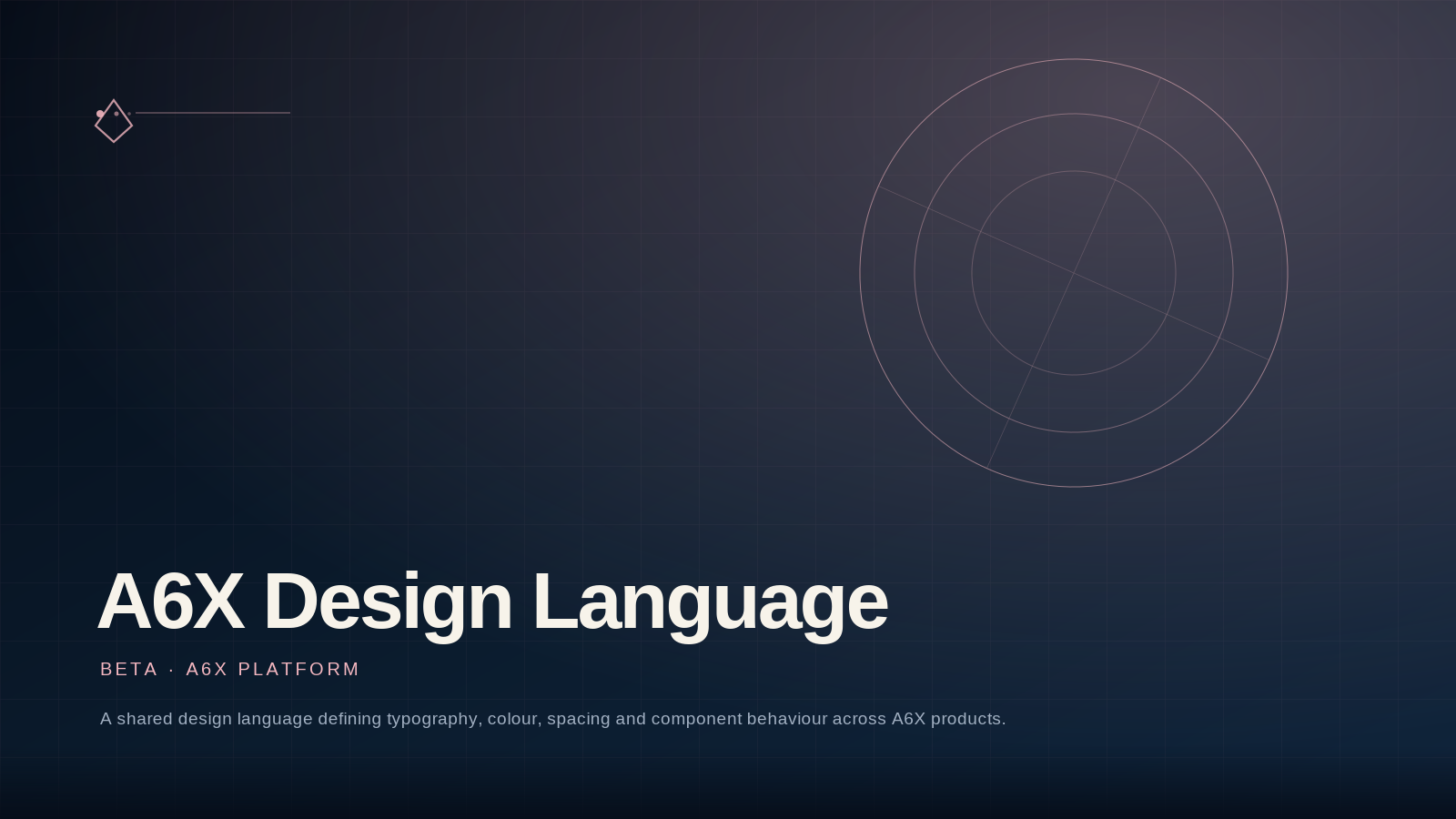
A6X Design Language
A shared design language defining typography, colour, spacing and component behaviour across A6X products.
Beyond the Known